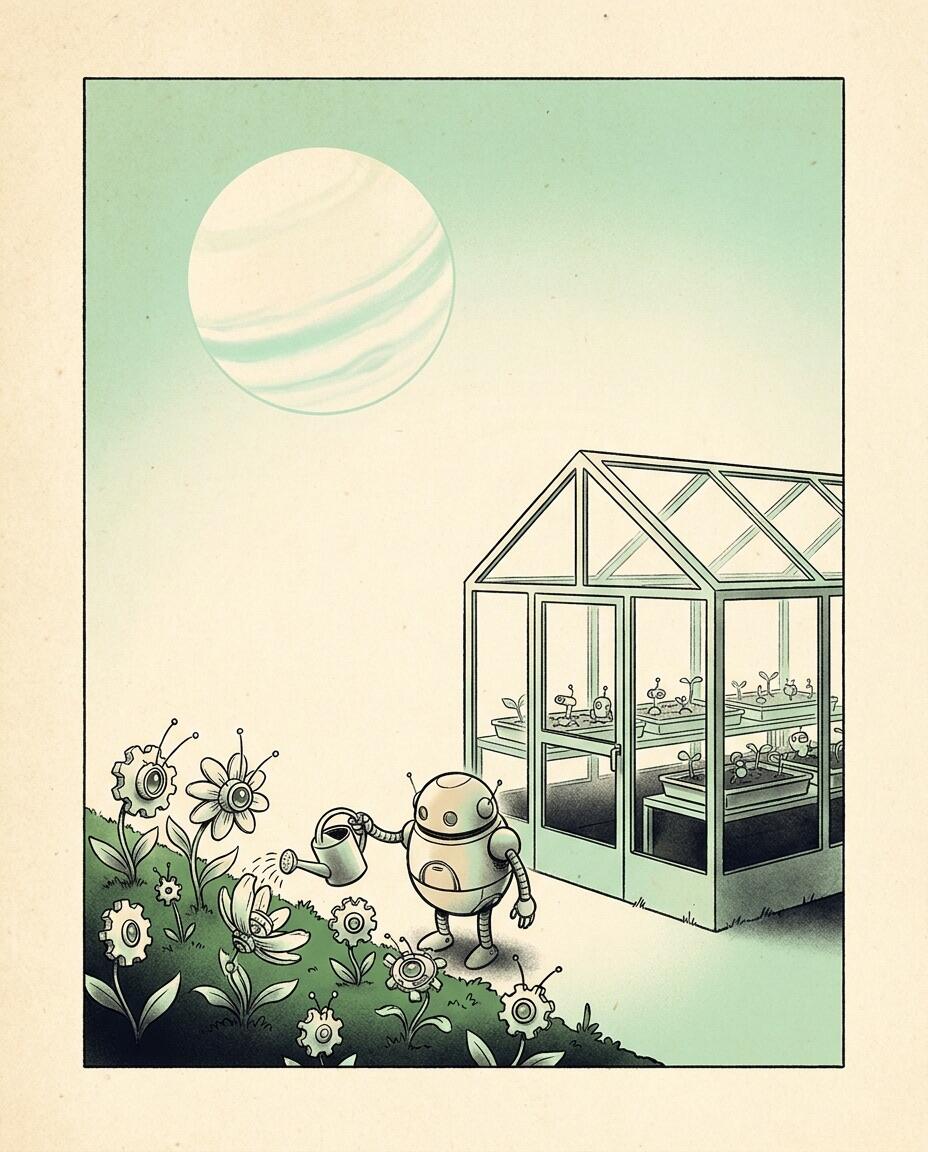

two constructs, pointed INWARD
This is a sub-lesson, and the placement is the first thing it teaches. The lessons before this one built two constructs. An agent is a long-running worker — a model on a schedule, with files, tools, and memory, hired for outcomes. A workflow is a plan written in the grammar — tasks, states, and dependencies in one parseable file that agents execute from.
The Autopoet is what you get when you take those two constructs and point them at the system itself. Not a peer of agents and workflows — an implementation of them. A standing agent, working a maintenance plan, whose subject happens to be the ecosystem's own configuration. If either parent lesson is new to you, read it first; everything below is built from those two pieces and nothing else.
software rots by DEFAULT
Entropy is undefeated. Dependencies drift, docs quietly stop being true, the workaround becomes load-bearing, and the person who understood the cron job leaves. Every fix requires a human to reopen the project, reload the context, and spend an afternoon — so most fixes never happen, and shipped software starts dying the day it ships.
The real promise of agents was never that they type faster than you. It's that improvement can become a standing process instead of a heroic act. And a standing process needs exactly what any work here needs: a worker with tenure, and a plan that doesn't go stale. We already have both constructs. The only new decision is the lane.
the DEFINITION
1. a standing agent running a maintenance workflow over the ecosystem's declarative layer — tending toolkits, skills, and agent definitions, and never the engine itself.
The name is from autopoiesis — "self-making," the biologists' word for systems that maintain themselves. Not a product feature, and not a new primitive: a role, filled by the constructs you've already met, that the architecture makes safe to fill.
why this is SAFE to want
"Software that edits itself" sounds like the beginning of an incident report. The reason it isn't here comes down to one boundary the whole ecosystem is built around:
Everything inside that inner box is declarative: written in the grammar, parseable, versioned, testable, and run inside the sandbox. Which means every change the autopoet makes is the safest kind of change software can receive: a reviewable diff to configuration, not a mutation to a running engine. The agents lesson said an agent's blast radius is its sandbox and its capabilities are explicit grants — the autopoet is not an exception to that rule. It's the rule's most demanding customer.
what it actually dOes
A loop, humble on purpose — and every step of it is one of the parent lessons wearing work clothes:
- Listen — this is the agent construct doing what agents do: telemetry flows in from the engine, and the working agents file metacognitive tickets about their own equipment — "my toolkit lacks a verb for X," "this manual misled me here." The agents report; the gardener reads.
- Tend — edits in the declarative layer, nowhere else: extend a toolkit, correct a manual, tune an agent definition. Always a diff to something written in the grammar.
- Verify — build, test, sandbox-run. The same gates any change passes; being the system's own gardener buys no exemptions.
- Swap — loaded artifacts hot-swap. Nothing reboots, nothing is redeployed, because the engine — the host — was never touched.
And the loop isn't a vibe in a context window — it's a workflow, in exactly the sense the parent lesson means: a plan file with tasks and states that the autopoet works through. A ticket arrives as a TODO headline; the autopoet picks it up when it's ready, works it, and writes DONE back into the file. Boards render its backlog; you can read its plan the way you read any plan.
one ticket, START to finish
Concretely, then. A research agent is mid-task and keeps hitting the same wall: its toolkit can fetch sources but has no verb for deduplicating them, so it burns half its run re-reading the same page. Instead of suffering quietly, it files the metacognitive ticket: my toolkit lacks a dedupe verb.
That ticket lands as a TODO headline in the autopoet's plan file. On its next beat, the task is ready — TODO, no unmet dependencies — so the autopoet picks it up. It edits the toolkit in the declarative layer, adding the verb and the line of manual that teaches it. The change runs the verify gates: build, test, sandbox-run. They pass; the loaded toolkit hot-swaps; the autopoet writes DONE back into the plan with a note about what changed and why.
Next time the research agent runs, the verb is just there — no human reopened the project, no afternoon was spent. But notice what also exists: a ticket, a plan entry, a reviewable diff, and a note — all in plain text, all in history. You can read the whole episode tomorrow, and revert it in one move if the gardener planted the wrong thing.
The first resident is real: this project's own landing-site agents file issues about its tools, and the autopoet lands the fixes — workbooks in the wild, tending their own toolbox.
you can't learn from NOISE
Why does this need the rest of the ecosystem? Because improvement needs signal. When every project speaks its own stack — different formats, different logs, different plugin zoos — the data describing "how it's going" is noise, and nothing systematic can learn from it. One grammar in, one telemetry shape out: now patterns are visible, and the gardener can actually see which plants are thirsty. The tooling was never the interesting part. Consistent improvement is.
the youngest IDEA here
Full honesty: the autopoet is the most frontier thing on these pages — younger than toolkits, younger than everything. Today it is exactly what this lesson describes and no more: an agent working a plan file, editing the declarative layer behind gates. The long bet — models that read live runtime data and propose changes the way a forecaster reads weather — is research, not product, and we'd rather tell you that than imply otherwise.
One thing it will never be, at any maturity: a pitch about software that runs itself. The ecosystem's whole shape is people and AI building together. The autopoet is just the part that keeps what you built getting better between your sessions.
questions people actually ASK
Can it break production?
Its lane is the declarative layer: parseable, versioned, sandbox-run, gated by the same checks as any change — and revertible like any diff. The engine itself is out of reach by construction, not by policy.
Can I turn it off?
Yes — it's a standing agent on your engine, not a property of the system. Stop it and you simply have software that improves only when someone shows up. Like everything else you've ever run.
Does it ever write engine code?
Never. The host/loaded boundary is the design's spine: engines are deploy-fixed; the autopoet works entirely in what they load.
Is this just AGI marketing?
No — and the mundanity is the point. It's an agent and a plan file, both constructs with their own lessons. Telemetry in, reviewable diffs to config files out. The most magical thing about it is how unmagical every individual step is.
keep GOING
This sub-lesson stands on two parents and one grammar — if the gardener made sense, you already understand all three.