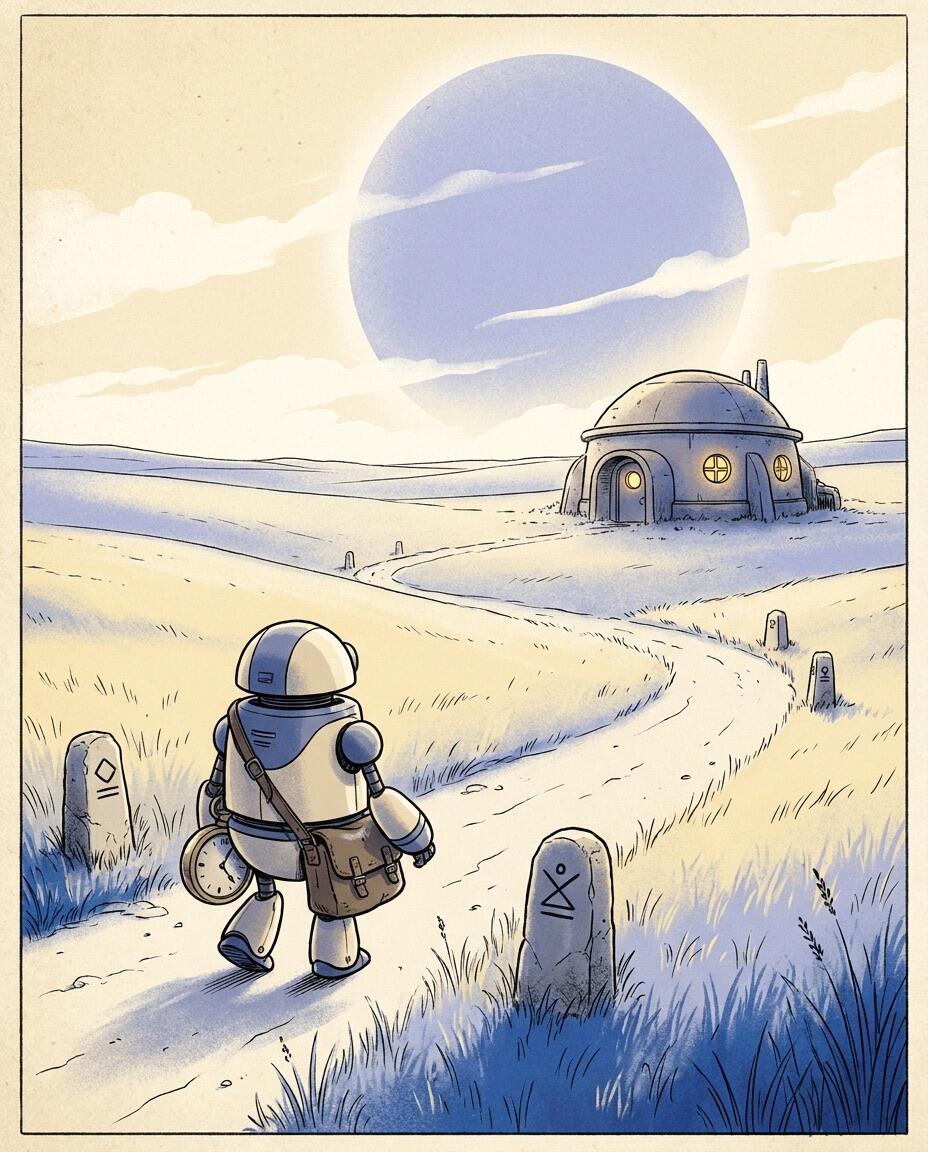

not a CHATBOT
Strip the hype and an agent is a simple construct: a model, in a loop, with tools. The strange part is how the industry runs them — like serverless functions, summoned for a message and evaporated after — and then wonders why they forget everything, repeat work, and can't be trusted with anything longer than a conversation.
But nothing about an agent is ephemeral. The whole point is memory, files, schedules, follow-through — time. People feel this so strongly they've taken to parking Mac minis in closets just to give an agent somewhere permanent to exist. The instinct is right; the hardware is silly. An agent isn't a function call. It's a long-running thing.
the DEFINITION
1. a long-running worker in the ecosystem: a model on a schedule, with files, tools, and memory, and a place to live — hired for outcomes, not messages.
The mental model shift is from conversation to tenure. You don't summon an agent; you give it a workspace and a beat, and it carries work between your sessions.
what an agent actually NEEDS
Four things — the same four a human colleague needs from a computer:
- Files — a workspace it owns. Here that's inside a workbook: the virtual file system riding in the artifact it's tending.
- Processes — real programs to run, in the workbook's WebAssembly lane, sandboxed by construction.
- Memory — not a vector database bolted on the side, but the workbook's org layer: notes, decisions, and task states it reads and writes like you do.
- Time — schedules, persistence, the ability to exist while you're away. That's what docking is for: the Nexus is where agents live.
Notice what's not on the list: your operating system. An agent here never touches it (the security model explains why that's structural, not polite).
one tool, many TOOLKITS
Agents in this ecosystem get exactly one tool: a shell. Every capability beyond it comes from toolkits — real programs on the path, each carrying the manual that teaches its use. No bespoke integration per tool, no N×M plugin matrix, no protocol zoo. An agent that can read a manual and run a command can use anything the ecosystem has — the same way you can.
the missing sense is tIme
Ask today's agents the questions that matter on real work — when did this happen? why did we decide that then? what was I doing before this? — and they shrug. Context windows hold text, not chronology.
Here, chronology is ambient. The org layer's tasks carry states and dates natively; the workbook carries its own history; telemetry is part of the substrate. An agent that can answer "what was I doing and why" is the difference between a goldfish and a colleague — and it falls out of the grammar, not out of a bigger model.
agents, not AUTOPILOT
Honesty section, and a values one. The pitch is never "software that runs itself" — it's people and AI building together. Agents here carry work between your sessions, file what they found, and stop at the edges you set. Direction stays human.
And the edges are real, not vibes: an agent's blast radius is its sandbox, its capabilities are explicit grants, and what it changes is written in a layer you can read, diff, and revert. Trust is earned in increments — the architecture is built so the increments are safe to give.
questions people actually ASK
Which models do agents use?
Any — the construct is model-agnostic. An agent definition names its model the way it names its toolkits; swap either without touching the rest.
Can an agent modify the system itself?
Only the declarative layer — toolkits, skills, definitions — never the engine. That boundary, and the standing process that works inside it, is the Autopoet's whole story.
How do I see what an agent did while I was away?
Read its org layer — the task states and notes it kept are the timesheet. Chronology being native is exactly what makes "catch me up" a real operation instead of an apology.
What does it cost to run one?
Your engine, your meter: agents live on a Nexus you own, so the marginal cost is model calls — not a per-second rental for the computer they exist on.
the deep DIVES
Go deeper into this area — the technical docs underneath it.
keep GOING
Agents write in the grammar, lives on the engine, and one standing member tends the whole garden.
