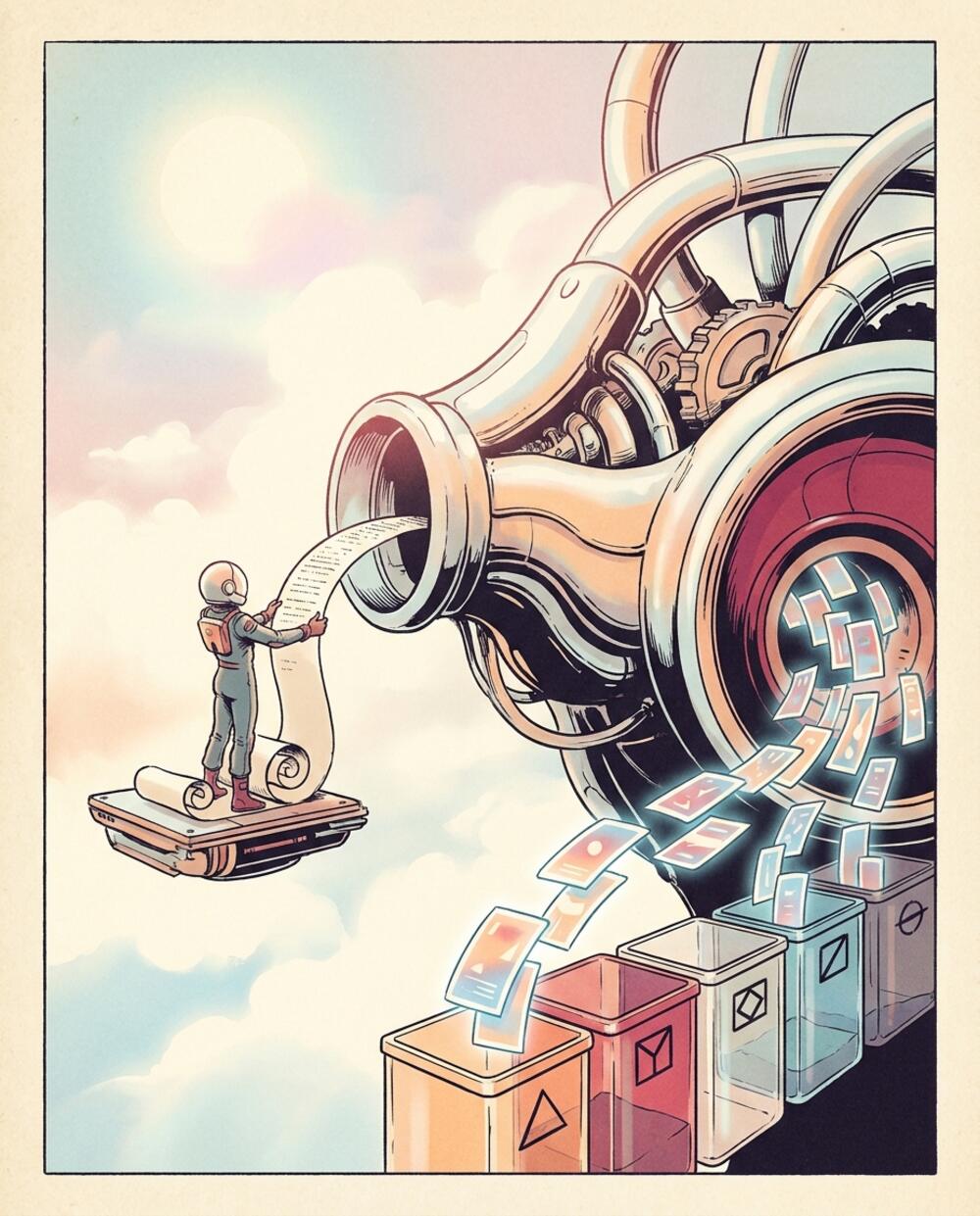

the temp-file TAX
You are generating org. A model emits a workflow; a script assembles headlines from an API; a Makefile wants a structure check before it ships. And the moment you reach for a normal CLI, the same sad loop assembles itself: write the org to a temp file, run the tool, scrape its human-shaped stdout back into structure, delete the file — and hope nothing crashed between step two and step four and left that file behind.
Every hop in that loop loses something. The temp file is a race and a cleanup liability. The prose output was built for eyes, so parsing it back into data is brittle guesswork. Most tools force this on you because their output was never meant to be a pipe's input — it was meant to be read.
Agents feel this most. An agent that has to mint a temp path, shell out, and regex the result burns turns on filesystem ceremony that has nothing to do with the work. The thing it actually wanted was simple — here is some org, tell me what's in it — and the tooling made it a four-step errand.
the DEFINITION
1. a composition of kernel verbs over
stdin and stdout: - is the file, JSON is the
medium, and the OQL kernel is the function — org flows in one end,
a typed build plan or a diagnostics array comes out the other, and nothing
is written to disk.
Three facts hide in that one sentence, and the rest of the page is just
them unpacked. - means read from the pipe, not the
filesystem. JSON means the output is already structure, so the next
stage doesn't parse prose. And "the kernel is the function" is the load
-bearing one: these verbs are pure functions exposed as processes, which is
exactly what makes them safe to chain.
three pure functions in a TRENCH COAT
There are exactly three local kernel verbs that take a pipe:
query, tangle, and lint. They sound
like three tools. They're closer to one — the whole dispatch lives in a
37-line file (cli/src/kernel.rs), and all three funnel through
one helper, read_org. That helper is where - earns
its keep: when the argument is a single dash it reads stdin to a string;
otherwise it goes through the I/O seam. Same code path on a native binary
and the in-sandbox wasm build — for these three verbs only.
flowchart LR
  in["stdin (-)  ·  or a path"]
  ro["read_org()"]
  q["oql::parse_headlines()"]
  t["oql::tangle_plan()"]
  l["oql::validate()"]
  out["JSON on stdout"]
  in --> ro
  ro --> q --> out
  ro --> t --> out
  ro --> l --> out
  style in fill:#d9dbd3,stroke:#121316
  style ro fill:#ffffff,stroke:#121316,stroke-width:2.5px
  style out fill:#13d943,stroke:#121316
After read_org the three verbs split for one line each:
query calls parse_headlines, tangle
calls tangle_plan, lint calls validate.
Each returns a JSON string and prints it — pure output, no rendering layer,
nothing that wants a terminal. That is the entire surface, and its smallness
is the point: there is almost no machinery between the org you pipe in and
the JSON you pipe out.
One honest nuance the source forces. The CLI's lint calls
the kernel's validate — not the kernel's own
lint export, which is currently a stub that returns an empty
array. The two are separate functions in the kernel's interface; the
diagnostics you get from wbx lint come from validate.
Don't picture lint calling lint.
what comes OUT
Three verbs, three JSON shapes. Knowing them by heart is what turns a pipe from a guess into a contract.
| verb | kernel fn | shape | one row per… |
|---|---|---|---|
| query | parse_headlines | array of headline objects | headline in the tree |
| tangle | tangle_plan | {worlds: […]} | compiled world |
| lint | validate | array of diagnostics | problem found |
A query row is a full lens on a headline:
level · title · state · id · tags · props · scheduled · deadline.
Timestamps don't come back as strings to re-parse — they come pre-cracked
into {at, repeat, active}. Here's a real one, verified against
wbx 0.13.0:
$ printf '* hello :tag1:\n** TODO child\nSCHEDULED: <2026-06-15 +1w>\n' | wbx query -
[{"level":1,"title":"hello","tags":["tag1"],…},
 {"level":2,"state":"TODO",
  "scheduled":{"active":true,"at":"2026-06-15","repeat":"+1w"},…}]
A tangle plan is the compile of a workflow: each world
carries its name, schedule, imports,
exports, a list of components (name, lang, deps,
uses, in, out, persist, src, dir), the edges between them, and
a workflows sub-array for any nested plans. A lint
diagnostic is the smallest of the three — just {level, scope,
message} — because a problem only needs to say how bad it is, where
it is, and what it is.
the plan is COMPUTED, not declared
Depth rung — skippable, but it's where tangle stops looking
like a formatter and starts looking like a compiler. You never write an
edge. You never list imports or exports. You write components with
:in, :out, and :uses header args, and
the kernel derives the wiring by matching producers to consumers.
flowchart LR
  subgraph plan["daily digest  :workflow:  (SCHEDULE 0 7 * * *)"]
    f["fetch  :component:
uses: http · out: raw"]
    s["summarize  :component:
in: raw · out: digest"]
  end
  http(["import: http"]) -. uses .-> f
  f -- "edge: out raw → in raw" --> s
  s --> dig(["export: digest"])
  style plan fill:#fbfaf6,stroke:#121316
  style http fill:#ffffff,stroke:#121316
  style dig fill:#13d943,stroke:#121316
Read the graph as a derivation. fetch declares
:out raw; summarize declares :in raw —
so an edge from fetch to summarize falls out of that match, nobody
drew it. digest is produced by summarize and consumed by no
one, so it's an export. http appears in a
:uses and nothing produces it, so it's an import. The
schedule comes from the :SCHEDULE: property as cron (or from a
SCHEDULED timestamp). The whole topology of the plan is a
function of the header args — change a name on one side and the edge
appears or vanishes.
And because headlines nest, so do plans: a :workflow:
heading inside another becomes an entry in the parent's
workflows sub-array, and the whole tree compiles into one
nested DAG. That recursion is the nesting lesson's
compile story — tangle is where you watch it happen.
jq is the OTHER half
The verbs emit JSON precisely so the next stage can be jq.
That's the composition surface: org in one end, a sentence of structure out
the other, with no file in between. Here's the no-temp-file tangle — a whole
workflow piped in, a one-line summary piped out:
printf '* daily digest :workflow:
  :PROPERTIES:
  :SCHEDULE: 0 7 * * *
  :END:
** fetch :component:
#+begin_src js :uses http :out raw
export async function run() { return fetch_feed(); }
#+end_src
** summarize :component:
#+begin_src js :in raw :out digest
export function run(raw) { return summarize(raw); }
#+end_src
' | wbx tangle - | jq -r '.worlds[] | "\(.name): \(.components|length) components, exports \(.exports|join(","))"'
→ daily digest: 2 components, exports digest. The full plan
carries the derived parts the summary skipped:
"edges":[{"from":"fetch","to":"summarize"}],
"imports":["http"], "exports":["digest"],
"schedule":{"cron":"0 7 * * *"} — none of it written by hand.
Or treat org as a database. Extract every open task by state:
$ printf '* plan\n** TODO write the fetch step\n** DONE wire the schedule\n** TODO add lint gate :ci:\n' \
  | wbx query - | jq -r '.[] | select(.state=="TODO") | .title'
write the fetch step
add lint gate
TODO state, tags, and SCHEDULED all survive the pipe — because org is a language, not formatting. The sequence has no filesystem in it, and that absence is the whole feature:
sequenceDiagram
  participant A as agent / script
  participant K as wbx tangle -
  participant J as jq
  A->>K: pipe generated org (stdin)
  K->>J: JSON plan (stdout)
  J->>A: one line of structure
  Note over A,J: no temp file · no cleanup · no disk
a gate that actually FAILS
Here is the gotcha, stated plainly so it never bites you in CI:
wbx lint exits 0 even when its diagnostics contain
errors. Diagnostics are data, not a process failure — the lint
run succeeded; it found problems. Verified:
$ printf '* pipe :workflow:\n** step :component:\n#+begin_src js :in nonexistent :out result\nexport function run(x){return x}\n#+end_src\n' | wbx lint -
[{"level":"error","message":"input `nonexistent` has no upstream producer","scope":"step"}]
$ echo $?
0        # diagnostics are data — the run succeeded
So a naive wbx lint file && deploy never blocks a broken
plan. The fix is to let jq turn the data into the exit code —
jq -e exits non-zero when its result is false:
wbx lint workbook.org | jq -e 'map(select(.level=="error")) | length == 0'
That exits 1 when any error exists and 0 when the array is clean — a gate that actually fails the build. Contrast it with a real failure: a missing file is an I/O problem, and those do set an exit code.
| what went wrong | exit | who catches it |
|---|---|---|
| org has a diagnostic (bad :in, no source) | 0 — data, not failure | jq -e |
| file not found / can't read | 4 — not found | the shell (&&) |
| clap usage error | 2 — usage | the shell |
The verdict: lint's exit code reports whether the
tool ran, not whether your plan is healthy. The shell catches I/O;
jq catches content. Wire both.
--json without DOUBLE-WRAPPING
Depth rung. Add --json and the raw output gets lifted into
an envelope — {ok, verb, data} on success — but the clever part
is what doesn't happen: the already-JSON output is embedded
structurally, not stuffed in as an escaped string.
data is the parsed array, so a downstream jq walks
it directly. Verified:
$ printf '* hello :tag1:\n' | wbx query - --json
{"data":[{"deadline":null,"id":null,"level":1,"props":{},
  "scheduled":null,"state":null,"tags":["tag1"],"title":"hello"}],
 "ok":true,"verb":"query"}
You rarely need to type --json mid-pipeline, though. Mode is
auto-detected: when stdout isn't a terminal, wbx assumes a
machine is reading and switches to agent mode on its own — so every middle
command in a pipe is already structured. The forcing knobs exist for the
edges: --json and --agent are global flags that
work on any verb in any position, and WBX_AGENT=1 pins it from
the environment. The full mode model — the exit-code map, the failure
envelope, the TTY rules — is its own page; this lesson only needs that the
pipe stays structured by default. See the parent lesson
for the whole contract.
your pipe is the engine's PARSER
This is the payoff that makes a shell pipeline more than convenient. The
kernel doing the work in wbx query is the same Rust
crate — package oql, runtime/kernel — that
compiles to the wasm Component the engine and desktop embed. The CLI links
it as a native rlib; the engine loads it as oql.wasm. One
logic, every surface.
flowchart TD
  crate[["oql — one Rust crate
parse_headlines · tangle_plan · validate"]]
  crate --> native["native rlib"]
  crate --> wasm["oql.wasm Component
(WIT world: workbooks:oql)"]
  native --> cli["wbx — your laptop"]
  wasm --> engine["the engine — server"]
  wasm --> desk["desktop · in-browser"]
  style crate fill:#d9dbd3,stroke:#121316,stroke-width:2.5px
  style wasm fill:#ffffff,stroke:#121316
  style cli fill:#13d943,stroke:#121316
The WIT world is deliberately austere — pure string-to-string, no host
imports, no WASI context. The kernel can't read your disk or hit the
network; faults trap inside the wasm engine. Which means there's no place
for the two builds to diverge: wbx tangle - on your laptop and
the engine's compile of the same file reach byte-identical conclusions,
because they're running the identical function. A pipeline on your machine
isn't an approximation of what the engine will do — it's a dry run of the
exact same logic.
where the pipe surface ENDS
Honesty section. The pipe is narrow on purpose, and it's worth knowing exactly where it stops today.
Only three verbs take -. query,
tangle, and lint special-case stdin; nothing else
does. The author and trust verbs — sign, bundle,
verify, workflow run, workbook deploy
— want real paths. Pipe into one and it fails honestly:
$ printf '* x\n' | wbx sign -
wbx: read -: No such file or directory     (exit 4)
The SPEC names "stdin pipelines across author/trust verbs" as un-shipped reach work — it's a known frontier, not an accident.
Lint's exit code doesn't reflect severity — the
gate section exists because of it; reach for
jq -e, not &&.
Exit-code classification is a text heuristic today. Under the hood, codes are currently inferred from error text — the source says so outright. The contract is the code (4 means not-found, whatever the message says); the text is not. Branch on the number.
Two kernel exports have no CLI verb. check_upgrade
(the upgrade gate) and render live in the kernel but are
engine and desktop surfaces — there is no wbx render, and
wbx upgrade is self-update of the binary, a different thing
entirely. Don't reach for verbs that aren't there.
questions people actually ASK
Why does lint exit 0 when there are errors?
Because diagnostics are data, not a crash — the lint run succeeded and
reported problems. The tool worked; your plan didn't. To fail a build on
errors, pipe to jq -e 'map(select(.level=="error")) | length ==
0', which returns a non-zero exit when any error is present.
Can I pipe into sign or bundle?
Not yet. Only query, tangle, and
lint special-case -. Sign, bundle, verify,
workflow run, and workbook deploy take real file paths, and piping into
them fails with a not-found error. The SPEC lists stdin across the
author and trust verbs as named frontier work.
Is the output stable enough to script against?
The JSON shape is the contract — headline rows, the worlds plan, the
diagnostic triple — and --json adds the envelope
(verb, ok, and on failure a typed
code). Branch on the structure and the code, not on prose;
the text inside a message may change, the shape is what you build on.
Do I need an engine running for this?
No. All three verbs are local — they link the kernel as a native rlib and read stdin directly. No server, no network, no auth. The engine runs the same logic, but your pipe doesn't call it.
What's the difference between lint and validate?
The CLI's lint calls the kernel's validate
function. The kernel exposes a separate lint export too, but
it's currently a stub that returns an empty array — reserved. So your
diagnostics come from validate; lint is just
the verb name you type.
Will my generated org ever hit disk?
Not in a pipeline. - reads stdin straight into memory and
the output is JSON on stdout. The whole reason the surface exists is to
delete the write-temp / run / parse / cleanup loop — there's no file to
race on and nothing to clean up.
keep GOING
Pipelines are one verb-set on a bigger command, feeding a bigger machine.

